
Oral Wegovy: A Complete UK Guide to the Wegovy Weight Loss Pill
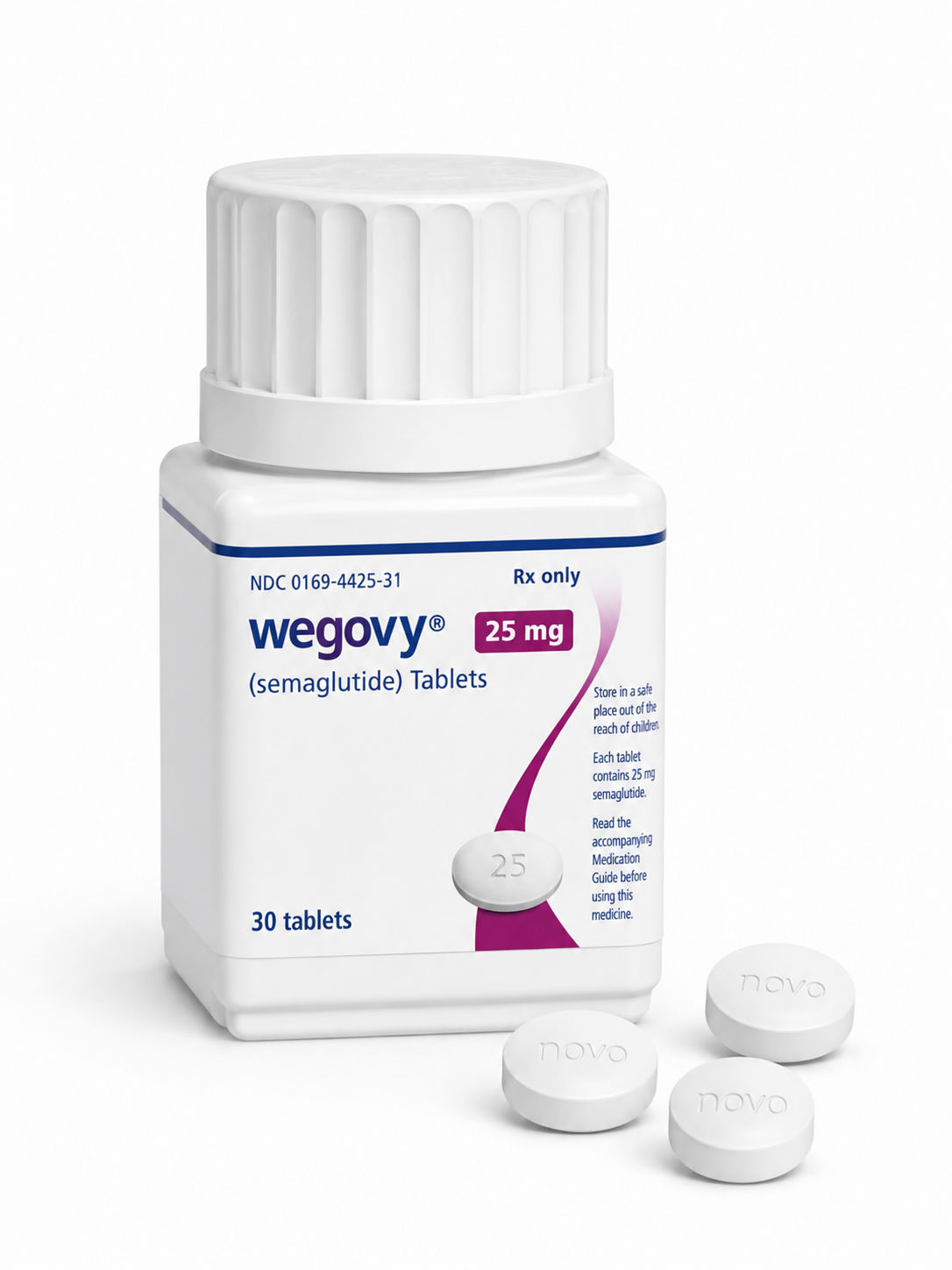
For years, effective weight loss medicine in the UK has meant a daily or weekly injection. For many people, self-injecting with a needle has been a barrier to treatment.
That changed on 11 June 2026, when the UK's medicines regulator, the Medicines and Healthcare products Regulatory Agency (MHRA), approved a daily semaglutide tablet for weight loss and weight management. Sold as oral Wegovy, it holds the same active medicine as the Wegovy injection but in pill form. It is the first oral GLP-1 weight loss medicine licensed in the UK, and for people who have considered this kind of treatment for years, the change of formulation offers a new route.
Five things worth knowing first
- Oral Wegovy is a once-daily semaglutide tablet, approved in the UK on 11 June 2026.
- People lost about 13.6% of their body weight in the main OASIS 4 trial, over roughly 15 months.
- It suits adults living with obesity, and some overweight adults with a weight-related condition.
- The biggest change from the injection is not the result. It is the daily empty-stomach routine.
- The pill is private-only for now, because the NHS has not yet agreed to fund it.
What is oral Wegovy?
Oral Wegovy is a once-daily semaglutide tablet, now licensed in the UK for weight loss. It carries the same active medicine as the Wegovy injection, in a form you swallow rather than inject. The MHRA approved it for adults living with obesity, and for some overweight adults who also have a weight-related condition.
Like the injection, the Wegovy pill needs a prescription. It is designed to support changes to your eating and activity, not to replace them. The new part here is not the medicine itself, since semaglutide is already well established. The real challenge has always been getting enough of it into the body from a tablet.
How does the Wegovy pill work?
Oral Wegovy works by copying a natural appetite hormone, and many people notice the change in how they eat well before the scales start to move. The biology behind it is straightforward. After a meal, your body releases a hormone called GLP-1 (glucagon-like peptide-1), which signals to your brain that you have had enough. Semaglutide mimics it closely. Acting on the appetite centres in your brain, it leaves you feeling full sooner, and that fullness lasts longer than it usually would.
Food stops dominating your thinking in the same way. The weight loss follows from there, gradually, as you eat less over weeks and months. The tablet and the injection do all of this in exactly the same way. Only the route into the body differs.
Who can take oral Wegovy?
Oral Wegovy is open to adults with obesity plus some overweight adults with a related condition. Obesity here means a body mass index (BMI) of 30 or higher. The overweight group qualifies at a BMI of 27 to 30, as long as they also have a weight-related condition such as high blood pressure or type 2 diabetes.
A number on its own does not decide things, though. A prescriber weighs up your wider health and your treatment history before recommending it. If you already use a GLP-1 medicine for weight, you almost certainly meet the criteria. Meeting the BMI figure is where the conversation starts, not where it ends.
How effective is oral Wegovy for weight loss?
In the OASIS 4 trial, people taking oral Wegovy lost about 13.6% of their body weight over roughly 15 months. People taking a placebo, which is an inactive pill used for comparison, lost about 2.2% over the same period. In real terms, 13.6% is around 13 to 14kg for someone starting at 100kg.
The trial authors judged oral Wegovy to sit in the same bracket as the 2.4mg Wegovy injection, so the pill and the injection land close together in terms of weight loss. Averages only tell you so much, though. A daily tablet only works when it becomes part of a daily routine. Your starting weight and your dose both shape the result, alongside the everyday changes you make.
How and when should you take oral Wegovy?
You take oral Wegovy once a day, on a completely empty stomach, with a small sip of plain water. For most people, that means first thing in the morning, after a gap of at least 8 hours without food. Swallow the tablet whole. Never crush or chew it. Then wait a clear 30 minutes before taking anything else, whether that is breakfast, your first coffee, or another tablet.
The wait is the part people underestimate, and it is the one rule that quietly decides how well the medicine works for you. Eat or drink too soon, and your body takes in far less of the dose. A practical approach is to take it as soon as you wake, then have breakfast and coffee once the half hour has passed.
Never take oral Wegovy alongside the injection, or with any other GLP-1 medicine, since that doubles up the same drug. Always tell your prescriber what else you take before you start.
What is the oral Wegovy dosage schedule?
Oral Wegovy starts at 1.5mg a day and climbs to 25mg in stages. Nobody begins on the full dose, because the body needs time to settle into the medicine. From 1.5mg, the steps go to 4mg, then 9mg, and finally 25mg, which is the maintenance strength. You hold each level for at least a month before going up.
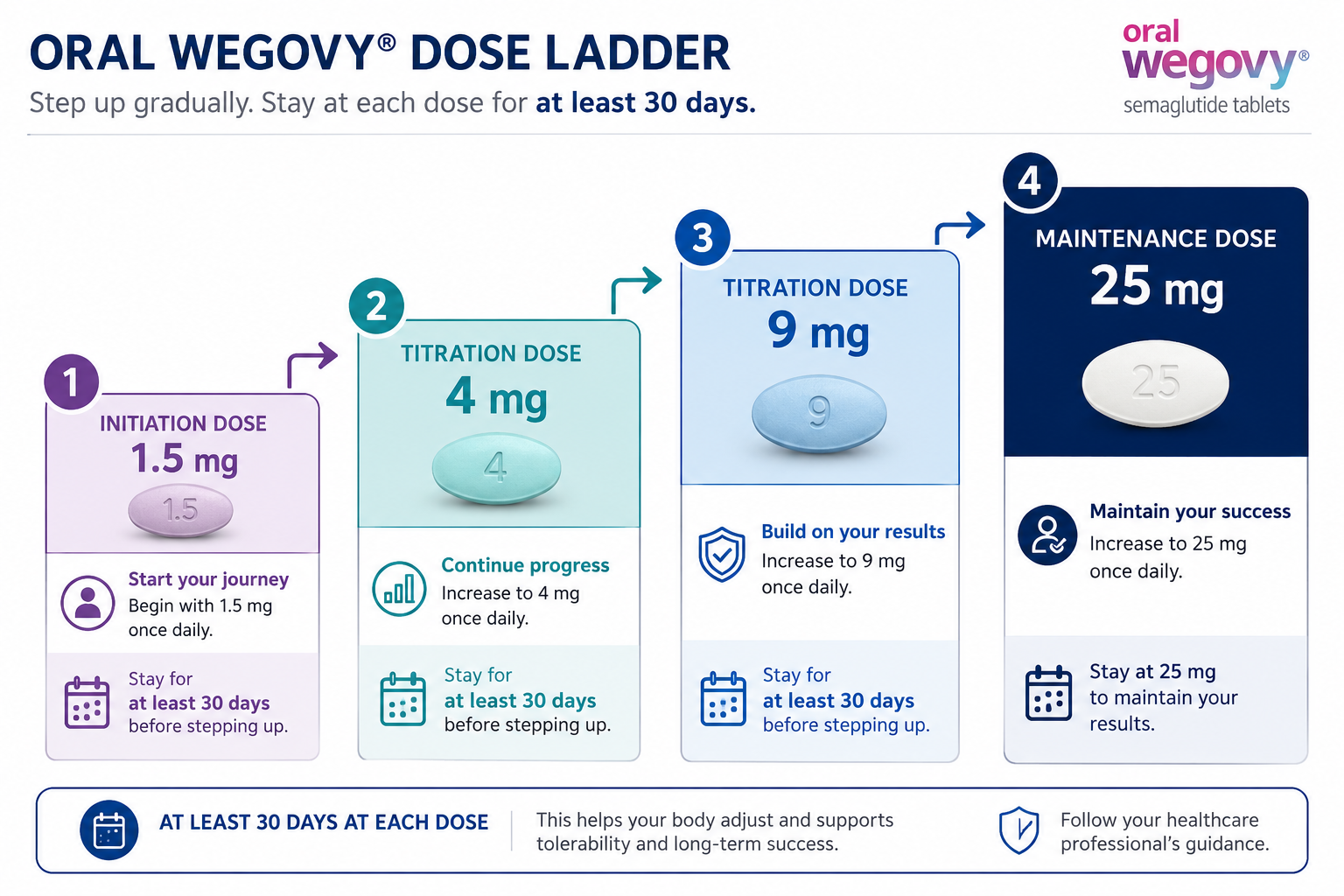
There is no benefit to moving through the steps quickly. If a step brings side effects, staying on it longer is often the sensible approach, and your prescriber can work through it with you. The aim is the lowest dose that controls appetite while staying comfortable.
Oral Wegovy vs the Wegovy injection: which should you choose?
Which option suits you depends less on the medicine itself and more on how it is taken. The tablet's appeal is obvious: no needles. For people who have put off treatment purely because of injections, that single fact can settle the decision.
The injection answers a different set of frustrations. It's dosed once a week, not once a day, and it carries no food or timing rules at all. For someone who travels often or who knows they will forget a daily tablet, the weekly injection may be the easier habit to keep. The injection range also now reaches a higher strength than the tablet, which appeals to people chasing greater weight loss.
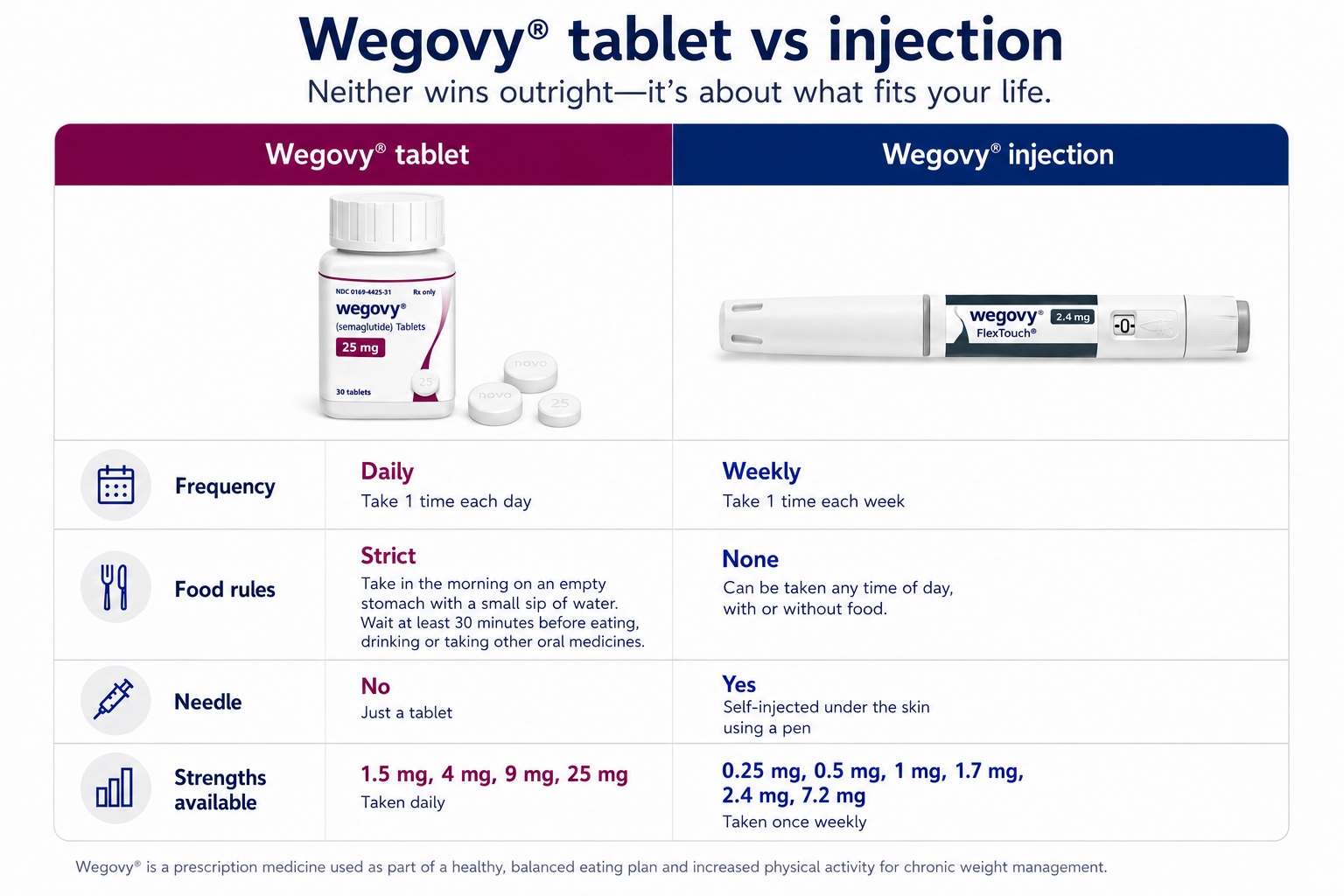
Neither option wins outright for everyone. If needles were always the sticking point, the pill is a genuine step forward. If a daily routine sounds harder than a weekly injection, plenty of people will still choose the injection for exactly that reason.
How do you switch from the Wegovy injection to the pill?
Switching is usually straightforward, but not always, and the difference comes down to your current dose. The cleanest route is for people on the top injection strength. The MHRA confirms that anyone on the 2.4mg Wegovy injection once a week can move directly to the 25mg Wegovy pill once a day. No dropping back to the starting dose and building up again.
On a lower injection strength, talk to us before changing anything, so we can match you to a sensible starting point. The same goes for Mounjaro, a different medicine called tirzepatide. No fixed swap links tirzepatide and semaglutide, so this is where prescribing turns more individual. We will take into consideration your current injection dose and how smoothly you handled your last couple of dose increases.
What are the side effects of oral Wegovy?
The common side effects are digestive, and nausea is usually the first thing people mention. Diarrhoea, constipation, and the occasional bout of vomiting are also commonly reported. These tend to cluster around dose increases, so the first step up is often where nausea is most noticeable. For most people, it fades within a few weeks as the body adjusts.
Smaller meals and going easy on rich food can help. Losing weight quickly can also slightly raise the risk of gallstones, which is worth knowing before you start. Anyone moving over from injectable semaglutide will find little here that feels new.
When should you get medical help on oral Wegovy?
Serious problems are uncommon, but a few are worth knowing in advance. Use this as a simple guide to who to contact and when.
For mild, expected effects, the Medy clinical team is your first port of call. That covers ongoing nausea or mild vomiting, changes to your bowels, reflux, and any dose questions.
Some symptoms call for same-day medical attention. Contact your GP or call NHS 111 if you notice signs of a gallbladder problem, such as yellowing skin or severe pain in the upper right of your tummy. Do the same for thyroid warning signs, like a new lump in your neck, a hoarse voice, or trouble swallowing. Get seen quickly, too, if vomiting stops you from keeping fluids down for several hours.
A small number of symptoms are emergencies. Stop oral Wegovy and call 999 or go to A&E if you develop severe tummy pain that spreads to your back, with or without being sick. That can signal pancreatitis, inflammation of the pancreas, which the MHRA has flagged as a rare but serious risk across this whole class of medicine.
Treat it as an emergency if you have a severe allergic reaction or signs of serious dehydration. Sudden problems with your vision are also urgent. If your eyesight suddenly goes, or quickly worsens, in one or both eyes, attend eye casualty or A&E. This can point to a very rare eye condition (called NAION) linked to semaglutide. If thoughts of harming yourself ever take hold, go straight to A&E.
Who should not take oral Wegovy?
Oral Wegovy is not suitable for everyone, and some histories either rule it out or call for extra care. Always give your prescriber the full list of medicines and conditions you have, even the ones that seem unrelated. It is the quickest way for us to confirm the tablet is a safe choice for you.
- Do not take oral Wegovy in pregnancy or while breastfeeding. The same applies if you are trying to conceive.
- You should not take it if you have ever had a serious allergic reaction to semaglutide.
- Tell us if you, or a close relative, have ever had medullary thyroid cancer (MTC) or the inherited condition multiple endocrine neoplasia type 2 (MEN2). As a precaution, we will not prescribe oral Wegovy where this history is present.
- Let your prescriber know if you have ever had pancreatitis, which is inflammation of the pancreas. Oral Wegovy is used with extra care after a previous bout.
- Tell us and your diabetes team before you start if you take insulin or a sulfonylurea for blood sugar. Oral Wegovy can lower blood sugar, so those doses may need adjusting to avoid a hypo (low blood sugar).
If you could become pregnant, use reliable contraception throughout treatment. The medicine also lingers in the body for some time after your last dose. Because of that, prescribers advise stopping it at least two months before you try to conceive. One practical point often catches people out. Severe vomiting or diarrhoea can make the contraceptive pill less reliable, so a backup method is sensible whenever you are unwell.
Oral Wegovy: frequently asked questions
How long does oral Wegovy take to work?
Within the first few weeks, most people notice their appetite shift before the scales move at all. The weight loss itself builds over months rather than days. The main trial measured its headline result at around 15 months.
What happens if you eat too soon after taking it?
Eat or drink inside the 30-minute window, and you simply absorb less of the dose. This is about how well the medicine works, not about safety. A one-off slip will not derail your progress. Many people only notice the effect of repeated mishaps after a few weeks of patchy results.
Can you take oral Wegovy with your other medicines?
One rule here is firm: never take oral Wegovy alongside the injection or any other GLP-1 medicine. Beyond that, timing is the main thing to manage. Other tablets, like the dose itself, should wait until at least 30 minutes have passed. Give your prescriber the full list of what you take, and they will sort out the order.
Can you drink alcohol on oral Wegovy?
There is no absolute ban, but a little caution goes a long way. Alcohol can irritate your stomach, which may add to any nausea, and it lowers blood sugar in its own right. Heavy drinking also works against the weight loss you are aiming for. If you do drink, keep it modest and see how your stomach handles it first.
Is the 25mg pill stronger than the injection?
It is a common assumption, but the answer is no. A bigger milligram number does not mean a stronger medicine. Oral semaglutide needs a higher dose because so little of a swallowed tablet actually gets absorbed. The tablet and the injection are simply measured on different scales, for different routes into the body. The 25mg Wegovy pill is considered roughly equivalent to the 2.4mg Wegovy injection, based on the trial data.
What happens if you stop taking oral Wegovy?
Over the months after stopping, weight tends to return. That holds true for every GLP-1 medicine. The appetite signal fades once the drug leaves your system, and earlier appetite levels return. This is exactly why prescribers treat weight management as a long-term plan rather than a short course. If stopping is on your mind, speak to us at Medy first so we can plan it properly.
How much does oral Wegovy cost in the UK?
No UK price for oral Wegovy is confirmed yet. We will share full pricing the moment it is set. Cost will follow your dose, much as it does with the injection. Existing Medy patients can ask about switching as soon as pricing and availability are confirmed.
Is oral Wegovy available on the NHS?
Oral Wegovy is not funded by the NHS yet, and approval and funding are two separate steps. The tablet itself has already cleared approval. NHS funding now rests with the National Institute for Health and Care Excellence (NICE), the body that judges whether a treatment is good value for public money. Reviews like this usually take many months, sometimes longer, so private prescribing is realistically the only route for a while yet.
Speak to the Medy team about oral Wegovy
A new option is genuinely good news, but the right call still depends on your circumstances. We already support patients using injectable GLP-1 medicines. If you are considering the tablet, our prescribers will check whether it suits you and start you on the right dose. If you already inject and want to move across, get in touch with the Medy clinical team.
References
- Medicines and Healthcare products Regulatory Agency. First GLP-1 tablet for weight loss approved in the UK. GOV.UK. 11 June 2026. Available from: https://www.gov.uk/government/news/first-glp-1-tablet-for-weight-loss-approved-in-the-uk [Accessed 11 June 2026].
- Wharton S, Lingvay I, Bogdanski P, Duque do Vale R, Jacob S, Karlsson T, Shaji C, Rubino D, Garvey WT, for the OASIS 4 Study Group. Oral semaglutide at a dose of 25 mg in adults with overweight or obesity. N Engl J Med. 2025;393(11):1077–1087. doi:10.1056/NEJMoa2500969. Available from: https://www.nejm.org/doi/full/10.1056/NEJMoa2500969 [Accessed 11 June 2026].
- Medicines and Healthcare products Regulatory Agency. GLP-1 receptor agonists and dual GLP-1/GIP receptor agonists: strengthened warnings on acute pancreatitis, including necrotising and fatal cases. Drug Safety Update. GOV.UK. 29 January 2026. Available from: https://www.gov.uk/drug-safety-update/glp-1-receptor-agonists-and-dual-glp-1-slash-gip-receptor-agonists-strengthened-warnings-on-acute-pancreatitis-including-necrotising-and-fatal-cases [Accessed 11 June 2026].
- Medicines and Healthcare products Regulatory Agency. Semaglutide (Wegovy, Ozempic and Rybelsus): risk of non-arteritic anterior ischemic optic neuropathy (NAION). Drug Safety Update. GOV.UK. 5 February 2026. Available from: https://www.gov.uk/drug-safety-update/semaglutide-wegovy-ozempic-and-rybelsus-risk-of-non-arteritic-anterior-ischemic-optic-neuropathy-naion [Accessed 11 June 2026].