
Foundayo (Orforglipron): A Complete Guide to the UK's New Weight Loss Pill
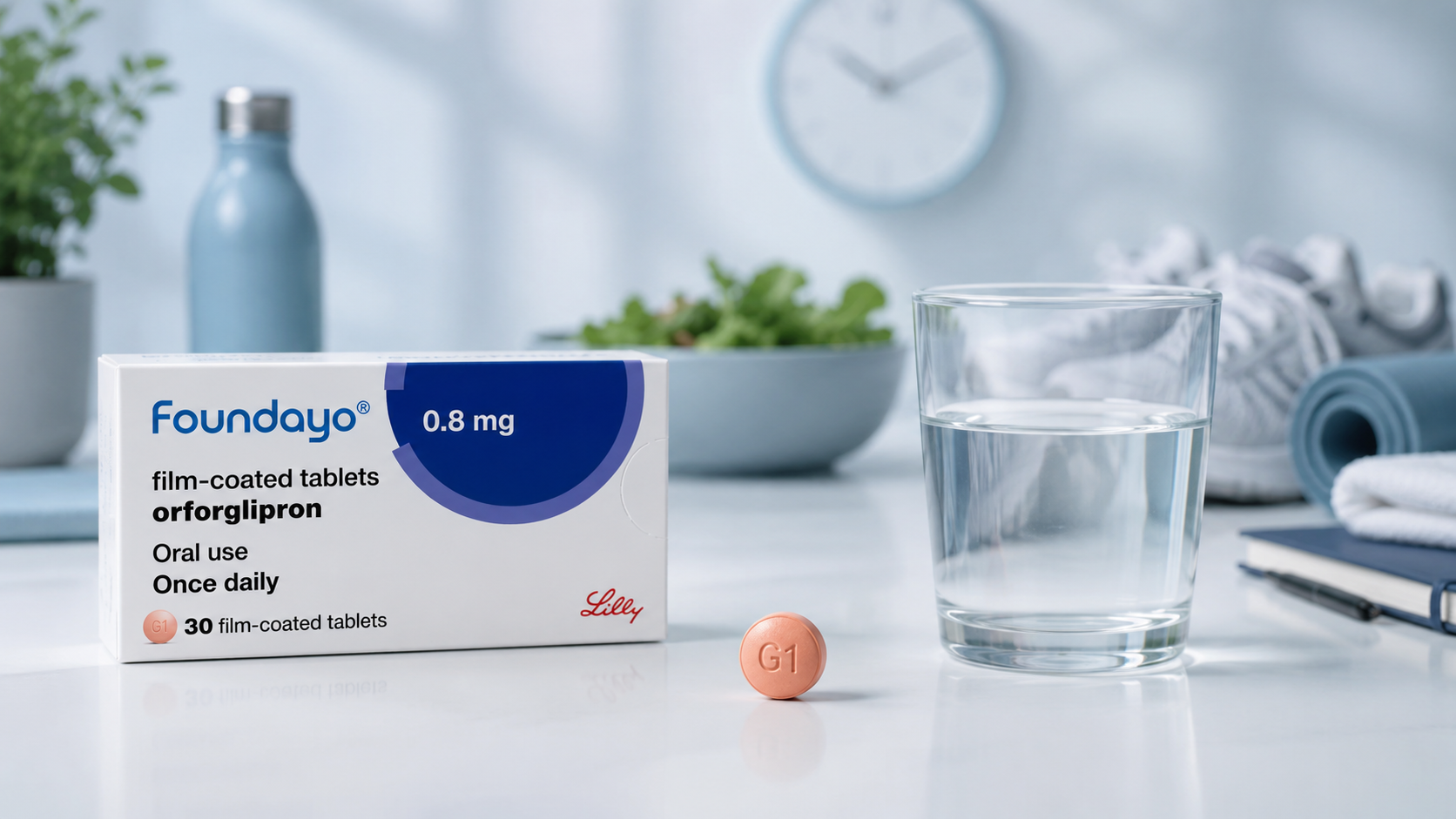
What is Foundayo?
Foundayo is a once-daily tablet for weight management, and its active ingredient is orforglipron. It is manufactured by Eli Lilly, the same company behind Mounjaro injections. The Medicines and Healthcare products Regulatory Agency (MHRA), the body that licenses medicines in the UK, authorised Foundayo on 10 August 2026.
The licence covers two separate uses in adults. The first is weight loss and long-term weight maintenance. The second is improving blood sugar control when type 2 diabetes is not well controlled. At Medy, we only prescribe Foundayo for weight management.
Foundayo belongs to the same family of medicines as Wegovy and Mounjaro, known as GLP-1 receptor agonists. Both Wegovy and Mounjaro are given as weekly injections, and Wegovy is also available in tablet form. Foundayo is the first non-peptide GLP-1 tablet licensed in Europe, and you swallow it once a day.
Who can take Foundayo?
Foundayo is licensed for adults with a BMI of 30 or above, or a BMI between 27 and 30 alongside at least one weight-related condition. The prescribing information names prediabetes, type 2 diabetes, high blood pressure, raised cholesterol, obstructive sleep apnoea, and heart disease as qualifying conditions. Treatment is designed to sit alongside a healthy, balanced diet and increased activity levels.
Foundayo is not suitable during pregnancy or while breastfeeding. If you are planning to become pregnant, treatment should stop at least three weeks beforehand.
Tell us if you have had pancreatitis, severe stomach or bowel problems, diabetic eye disease, or severe liver problems. We will review these before deciding whether Foundayo is suitable for you. Foundayo has also not been studied in people with the most advanced stage of heart failure, and it is not recommended for them.
How do I take Foundayo?
- Take one tablet a day, at any time of day, with or without food. There is no restriction on water.
- You must swallow each tablet whole, and do not break, crush, or chew it.
- If you miss a dose, take it as soon as you remember, and never take two tablets in one day.
- If you miss several days in a row, contact us before restarting.
Everyone starts treatment at the lowest strength, 0.8mg. The licence sets out six strengths in total, and 17.2mg is the highest. Each strength is taken for at least 30 days before any increase.
Step | Tablet strength | Minimum time before moving up |
1 | 0.8mg | 30 days |
2 | 2.5mg | 30 days |
3 | 5.5mg | 30 days |
4 | 9mg | 30 days |
5 | 14.5mg | 30 days |
6 | 17.2mg | Highest licensed dose |
At Medy, you decide when to move up. Once you have spent at least 30 days on your current strength and feel ready for more, you can request the next one. Our clinical team will review every request before approving your next prescription.
Some people choose to stay on a lower strength because they are seeing consistent results and no side effects. Not everyone needs to reach the maximum dose.
Why the doses in the studies differ from your tablets
The ATTAIN-1 phase 3 studies used hard capsules ranging from 1mg to 36mg in strength. Foundayo was then manufactured as a film-coated tablet. A 17.2mg tablet delivers the same amount of orforglipron as the 36mg capsule used in the main trial. The numbers differ because the tablet and the capsule are made in different ways.
How does Foundayo work?
Foundayo mimics GLP-1, a hormone your gut releases after you eat. GLP-1 reaches the parts of your brain that control appetite and signals that you have had enough. Orforglipron switches on those same receptors, so you feel full sooner and for longer. Your stomach also empties more slowly than usual. Food sits there longer, and smaller portions start to feel like enough.
Foundayo acts on blood sugar as well. It prompts your body to release insulin when your blood sugar runs high, for example, after a meal or a sugary snack. Your liver also holds a store of sugar and releases it between meals to keep your levels steady. Foundayo turns that release down a little.
How much weight can you lose on Foundayo?
People taking the highest dose of Foundayo lost an average of 11.2% of their body weight over 72 weeks. If you're starting at around 100kg, that comes to around an 11 kg loss. ATTAIN-1 followed 3,127 adults who had obesity, or who were overweight with a related health condition, and none of them had diabetes.
Daily dose (trial capsule) | Average weight change at 72 weeks |
6mg | −7.5% |
12mg | −8.4% |
36mg (equivalent to the 17.2mg tablet) | −11.2% |
Placebo group (taking an inactive pill) | −2.1% |
The trial figures above average the results of everyone who took part, including people who stopped treatment early. The UK prescribing information quotes 12.4% instead, which is an estimate of what the average would have been had nobody stopped.
More than half the people on the highest dose lost at least a tenth of their body weight. Around a third lost at least 15%.
What are the side effects of Foundayo?
Digestive symptoms are the main side effects of Foundayo. These include nausea and diarrhoea, as well as constipation, vomiting, indigestion, and stomach pain. Each of them affects more than one person in ten.
Digestive effects are at their worst while your dose is increasing, and they were more frequent at higher doses in the trials. Around six in ten people were affected at the 5.5mg strength, against closer to seven in ten at 17.2mg. Fewer than one in 20 were rated severe.
In the weight management trials | Foundayo | Placebo |
Had any stomach-related side effect | 68.7% | 36.3% |
Stopped treatment because of one | 6.8% | 0.6% |
Gallstones | 1.3% | 0.6% |
Hair loss | 3.7% | 1.8% |
Resting pulse above 100 beats a minute | 2.7% | 1.2% |
The first two rows are for the highest dose, and gallstones, hair loss, and heart rate cover all doses combined.
Less frequent effects include dizziness, headache, low blood pressure, heartburn, bloating, wind, and tiredness. Hair loss reported in the trials was temporary and tied to rapid weight loss rather than Foundayo itself.
Which medicines interact with Foundayo?
It is important that you tell us about every medicine you take, including anything a GP or dentist prescribes after you have started. You should also include any over-the-counter medicines you buy, and any vitamins, herbal medicines or supplements you take. Some combinations change your maximum Foundayo dose, and others need a change to the second medicine.
The contraceptive pill may not work as reliably while you take Foundayo. The prescribing information advises switching to a non-oral method, such as injections, patches or an intrauterine device (coil). Alternatively, add a barrier method such as condoms. Continue the extra or alternative contraception for 30 days after you start Foundayo. Do the same for 30 days after each dose increase.
- Speak to your GP if you are prescribed simvastatin, as your dose may need adjusting when you start taking Foundayo.
- Some medicines, such as clarithromycin and ketoconazole, can block Foundayo from breaking down in your body. We will prescribe a maximum dose of 9mg if you use these medicines.
- Rifampicin, phenytoin, and St John's wort weaken the effect of Foundayo. If you take any of these, Foundayo may not be a suitable option for you.
- If you take insulin or a sulfonylurea for your diabetes, let your diabetic care team know before you start taking Foundayo. They can monitor you closely and make any necessary adjustments to your medication.
What to do if you feel unwell on Foundayo
Most side effects on Foundayo settle on their own once your body adjusts to treatment. Refer to the following table for symptoms that require more urgent attention.
Symptom | Why it needs checking | Who to contact |
Nausea, constipation, or diarrhoea you can manage at home | Usually settles, and we can help you manage it | Message us |
Vomiting or diarrhoea, and you cannot keep fluids down | You may become dehydrated | GP or NHS 111 today |
Yellowing of your skin or eyes, or severe pain in the upper right of your stomach | Your gallbladder or liver needs checking | GP or NHS 111 today |
Shakiness, sweating, or confusion, if you take insulin or a sulfonylurea | Your blood sugar may be too low | GP or NHS 111 today |
A fast or pounding heartbeat that does not settle | Your heart rate needs checking | GP or NHS 111 today |
Severe stomach pain spreading through to your back | Needs urgent assessment | Stop Foundayo and call 999 or go to A&E |
Sudden loss of vision, including in one eye | Needs urgent assessment | Stop Foundayo and call 999 or go to A&E |
Swelling of your face, lips, or throat, or trouble breathing | Needs emergency treatment | Stop Foundayo and call 999 or go to A&E |
If you are unsure what to do about a side effect, contact us. For severe or rapidly worsening symptoms, get urgent medical help.
Is Foundayo available on the NHS?
Foundayo is available on private prescription only for now. A UK licence does not mean the NHS automatically funds a medicine. The National Institute for Health and Care Excellence (NICE) is reviewing orforglipron now. Its guidance is expected on 18 November 2026. If approved, funding may take a number of years to follow through.
Prices vary between providers because each pharmacy and online service sets its own. At Medy, we aim to be fair and transparent with our pricing.
Frequently asked questions
Is Foundayo a tablet version of Mounjaro?
No, Foundayo and Mounjaro are different medicines. Foundayo contains orforglipron, and Mounjaro contains tirzepatide. Orforglipron acts on one hormone receptor, and tirzepatide acts on two. Eli Lilly makes both of these medicines.
Can I switch to Foundayo from a weekly injection?
Speak to us before you change anything. Where you start on Foundayo depends on what you have been taking and how well you tolerated it. If you start at a lower strength than you are used to, appetite tends to return while your dose builds back up.
How long will I need to take Foundayo?
The licence covers long-term weight maintenance as well as weight loss. This allows you to take Foundayo long-term, if appropriate. Appetite and weight may both increase again once treatment stops.
How does Foundayo compare with the weekly injections?
Results from separate trials cannot be compared reliably: the participants, the doses, and the follow-up periods all differ. But as a rough guide, the averages published for the Mounjaro and Wegovy injections are higher than those published for Foundayo.
Does Foundayo protect the heart?
Foundayo is not licensed to reduce the risk of heart attack or stroke. The trials showed no increase in either, but none of them were designed to test whether Foundayo protects the heart. The Wegovy injection does hold a licence for lowering that risk and may be a sensible option if you already have heart disease and weight to lose. Contact our clinical team for advice on which treatment may be the best option for you.
Will Foundayo work without diet changes?
Every trial participant received advice on healthy eating and physical activity alongside the tablet. The published results reflect both of those together.
If you are considering Foundayo, speak to our clinical team about whether it suits your medical history.
References
Medicines and Healthcare products Regulatory Agency (2026) UK first in Europe to authorise orforglipron for weight management and type 2 diabetes. London: GOV.UK. (Accessed: 24 August 2026).
Eli Lilly and Company Ltd (2026) Foundayo 17.2mg film-coated tablets: summary of product characteristics. Electronic medicines compendium. (Accessed: 24 August 2026).
Wharton, S., Aronne, L.J., Stefanski, A., et al. (2025) Orforglipron, an oral small-molecule GLP-1 receptor agonist for obesity treatment, New England Journal of Medicine, 393(18), pp. 1796-1806. (Accessed: 24 August 2026).
National Institute for Health and Care Excellence (2026) Orforglipron for managing overweight and obesity [ID6516]. (Accessed: 24 August 2026).